Between Us: Waad Janbi and Mohammed Alghamdi
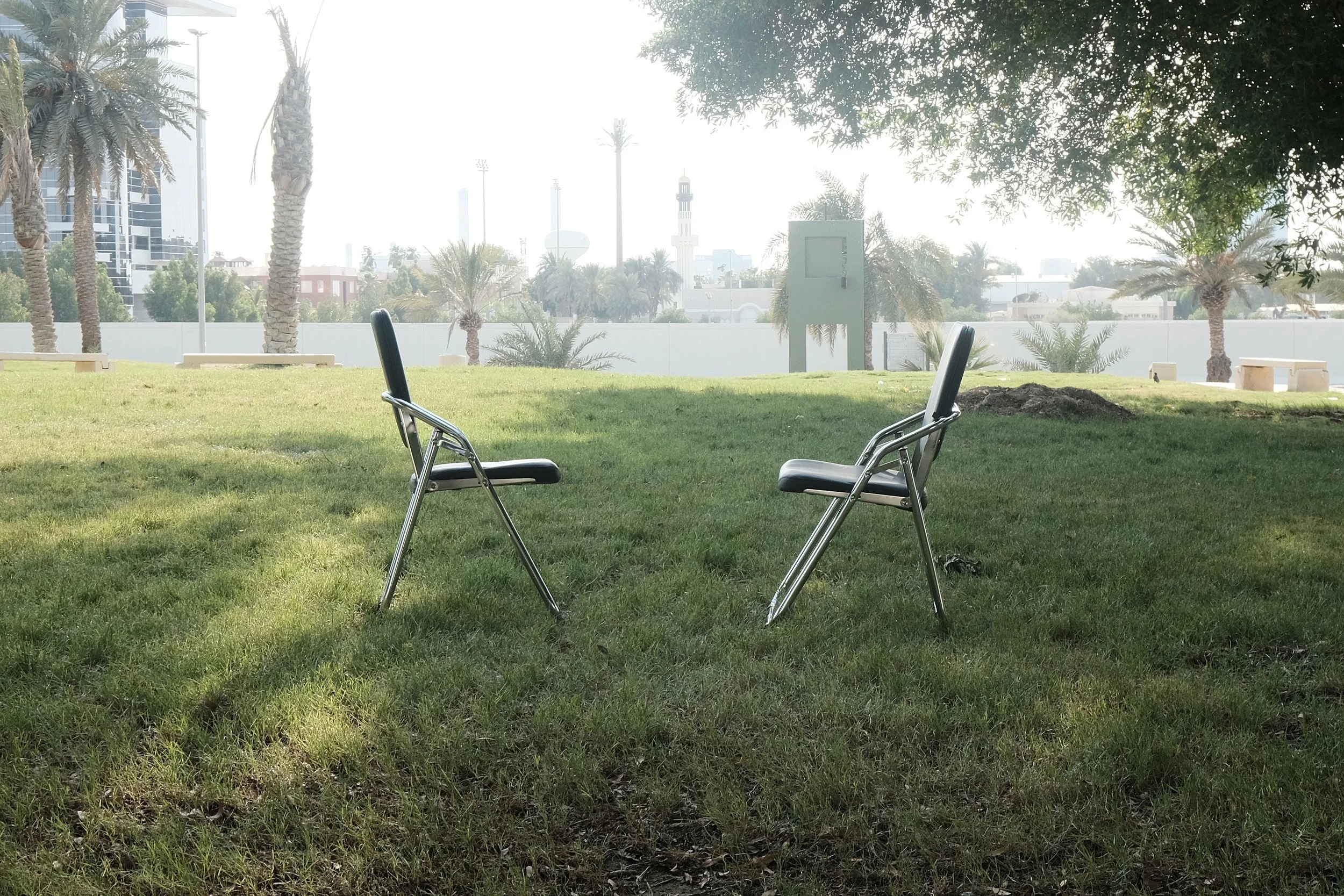
We kickoff Issue 29 of Ward with Between Us, a series of conversations between creatives whose practices overlap and nurture one another. This series is rooted in collaboration as the building block for cultural work, with each conversation recorded in public spaces that are reclaimed as meeting grounds where ideas emerge and kinships form between artists beyond, and in spite of, institutional support.
For its first iteration, we invited writer Waad Janbi and actor Mohammed Alghamdi to Rawdah Park in Jeddah, where they revisited the first time their paths crossed. Their conversation soon turned to how and why they fell in love with cinema, the stories they hope to tell, and the weight of putting one’s own life and experiences up for others to see and dissect on the screen.
Mohammed: How did we first meet, and what was our first impression of each other?
Waad: I remember that before I met you at Fennec, I saw a video of you talking about a film by Maha Al-Saati, who is the greatest Saudi woman filmmaker to me . When I saw someone appreciating her work, I knew I had to meet you. I remember seeing you at Fennec and telling myself, “We have to become friends, and we have to work together.” Then, when I followed you on Instagram, I came across another video of you acting in a theatrical sketch, and it really moved me.
Mohammed: I also remember seeing you at Fennec, during a workshop led by Lana Komsany called “Move.” I remember sitting in Fennec’s outdoor courtyard at Hayy Jameel with Lana, Ismail Bukhair, and Abdullah Al-abbasi, and several other people. I liked how clearly your personality came through. You weren’t afraid to express yourself, and you weren’t afraid to try something outside your usual comfort zone, like expressive movement.
Waad: Fennec was something new for me. I had returned to Jeddah from the United States a few years earlier, so it was wonderful to find a community like that, where I could be myself, express myself creatively, and feel in my element.
Mohammed: It was something new for all of us. As an actor, I use my body in acting and performance, but using it as a tool to move emotions and tell stories was something entirely new to me. It was lovely to explore it together as a new art form. I feel like I carried that experience with me into my life beyond the workshop and beyond the space we were in. Did you end up taking part in the final performance?
Waad: No, I ran away!
Mohammed: Why did you run away?
Waad: I really enjoyed the workshop as a whole, but when it came to the final performance...
Mohammed: I felt like you would have enjoyed it.
Waad: But I was very aware of my body. That’s something I genuinely appreciate about actors. Was your character the villain in that performance?
Mohammed: Essentially, the idea was for each group of participants in the “Move” workshop to create a performance using expressive movement without speaking. You tell the story through your body and facial expressions. I remember that the role I played was someone who opposed the group. It was a role I had never played before, and I joined that group at the last minute. They really trusted me with the role. And I found it so enjoyable, because maybe I’m a good person in real life, right?
Waad: Your performance was wonderful. I don’t remember the entire performance in detail, but I remember your role very clearly. Everyone else had their heads lowered, while you were holding your head up and carrying a knife. Not a real one, of course.
Mohammed: It was one of the best days of my life. Everyone wanted to collaborate and connect with one another. Everyone was trying to create something. That night was the first time I had seen so many people gathered together to watch something, and they all enjoyed the entire performance. I loved watching the other performances, too, because I had no idea what each group was planning to do. But why did you leave at the last minute?
Waad: Honestly, I knew the workshop was about acting, so I thought, let me give it a try, especially since I’d tried acting at university in short films. But when I realized it involved expressive dance and connecting with your body, I knew I didn’t want to do it, because I’m not really connected to my body. That’s something I appreciate about actors and dancers. I still feel cringe whenever I watch videos of myself. So when the final performance came around and I had the option to leave, I ran away from it. I also would have missed the chance to watch you perform if I’d taken part in the show.
Mohammed: But you could have performed and watched me at the same time.
Waad: But it wouldn’t have been the same.
Mohammed: Since you mentioned that feeling of embarrassment, I think it’s really important for an artist who wants to appear on a stage, in front of an audience, to separate themselves from the question of how other people see them, or how they see themselves. In theater, I can’t see myself, but people can see me. With cinema, though, I often try to avoid watching scenes back because it affects how I’ll see myself afterwards. For example, if I watch a scene and see how it was filmed, I’ll keep thinking about what I look like: “So this is how I look, which means I need to do this.” As an actor, I don’t need to occupy my mind with all these things. I really need to trust the director. If the director likes it and says it’s good, that’s all I need.
Waad: I think that’s a natural feeling for an artist. For example, when my film was screened, I wished I could hide under the seats. I felt as though I was emotionally exposing myself in front of the audience. People were looking at my thoughts and my story. I feel that, as artists, we bring out this part of ourselves and put it in front of people, then tell them, “criticize us” or “love us.” We do this all the time. So I think it’s completely natural to feel this way.
Mohammed: Speaking of your film, I feel like this particular year has been one in which both our film projects have made their way out into the world.
Waad: And you’re in Norway, for example! Mashallah!
Mohammed: Your film was screened at Hayy Jameel’s cinema. Was there another screening somewhere else?
Waad: The film I wrote and directed, Etizan (Grace), was screened at Hayy Jameel. My other film, Almashhad (The Scene), which was written and directed by Lana, was screened at the Red Sea International Film Festival and the Saudi Film Festival.
Mohammed: I feel like the film you directed, Grace, marked a new chapter in your journey.
Waad: Absolutely. It was really frightening. Even though Jeddah is the city I live in, and the people here are very much like me, and Hayy Jameel, in general, is a place that feels a lot like me, the whole idea was incredibly intimidating.
Mohammed: Why?
Waad: It was a new feeling for me, and even now, I don’t have the words to describe what I felt at the time. Now it feels like a dream that has come and gone, even though the film stayed in cinemas for a month and a week.
Mohammed: It screened for a long time.
Waad: Yes, experiencing those feelings was interesting.
Mohammed: Were you able to get inside the audience’s head at the time, or were you stuck inside your own?
Waad: No, honestly, I stayed inside my own head. The truth is, I have imposter syndrome. If you came up to me and said, “Waad, I really loved your film. Your film is so good,” I’d tell you, “You’re lying!” Seriously, my work? Is that really what you’re talking about? It’s something I’m currently working on improving in myself.
Mohammed: I completely understand. I understand where you’re coming from. Literally, one of my dreams has been to see myself on a cinema screen. Cinema is my favourite place in the world. When that dream came true this year, it was an entirely different experience.
Waad: Tell me about it. Go back to the beginning and tell me how you felt when you went to Norway and watched your film. And what was the film?
Mohammed: The film was Last Time I Dreamt About Diamonds by director Talal Alotaibi. We were accepted into a short film festival in Norway, one of the country’s most established film festivals. It was an opportunity I didn’t want to miss, especially because it was our first film to be screened, and the first film I’d acted in to be shown on screen. I felt that if I didn’t go, I’d regret it later.
The experience was beautiful, but you can’t really anticipate what it will feel like. You can predict things and imagine different scenarios in your head. You might tell yourself, “At this moment, I’ll experience this,” or, “I’ll feel this way.” You can even rehearse that moment in your mind. But when it actually happens, all you can do is surrender to it, because you experience feelings that are entirely new to you, or feel things in the way you described earlier. I was sitting in a room full of people, none of whom spoke my language, and this might have been the first Arab film they had ever seen.
Waad: What were their reactions like?
Mohammed: There was a Q&A session afterwards, and people were engaged and curious about the subject and the performances. The fact that a Saudi Arabian story had reached that audience was incredible to me. How did that even happen? That’s what I love about art: you can communicate through language, or even without language, and those things, those feelings, still reach people.
And, as you said, when I saw myself in the film, I felt that same kind of embarrassment. Not because of anything in particular, but because it’s really strange to watch yourself doing something when you’re no longer that person at that moment. You’re presenting something else. But when the director’s name, my name, and the cast’s names appeared at the end, I felt a sense of accomplishment.
Waad: When my film was screened at Hayy Cinema, there was a Q&A afterwards, and you were moderating the discussion. That was what I was most excited about, because the idea of being there, with people asking me questions, was so exciting to me.
When I was there, I was shaking. Even when my body is alert and fully awake, it still reacts that way. But what helped me at the time was having familiar faces among the audience, my friends, and having you there asking the questions. You’re someone who appreciates art, and you represent a safe space for me. You’re sensitive, and I really loved that you were the moderator. If there were anyone who deserved to do it, it would definitely be you.
Mohammed: When they asked me to moderate the discussion, they told me there would be four sections, and that I’d be moderating one of them. At first, I thought they’d let me choose just one section. But when I watched your film, along with some other films I loved, I immediately asked them, “Could I moderate this section?” They said, “Yes, you’ll be moderating that section.” I think it’s important for an artist to be curious, so I was happy to be curious with you all and ask you these questions. As you mentioned, it was a way of supporting you, supporting filmmakers, and supporting short films that audiences don’t often get the opportunity to see.
Waad: That’s one of the most important things the film industry should be built on: artists supporting one another and showing up to watch each other’s work. It bothers me that the industry is built on excessive flattery and personal interests. No one seems to have enough time to talk about it. We complain about it, but no one speaks about it loudly enough.
For example, your film was the only Arab and Saudi film at the festival, yet it still managed to reach people. I believe art is universal, and that art is about humanity. So how can art come from us and reflect who we are, yet we don’t make it a priority? I think the younger generation is more aware of this issue and is actively working to change it.
Mohammed: Have you ever felt that you were doing work that didn’t resemble you or represent who you are?
Waad: When I started working, I worked as a writer. I’ve spent my whole life writing and wanting to write. Even when I began working in film, I was supervising scripts. As a woman writer, I worked on scripts I didn’t actually want to work on. Some of them, for example, had a very male-centred perspective and included biased elements. But I did them because they offered professional recognition and experience.
I have a strong eye for detail when it comes to script supervision, and I pay attention to every role. Even when I worked on films whose stories bothered me, I would focus on each member of the crew and their role in making the film. It’s something I try to do in life generally: find something to take away from every experience, even if I didn’t enjoy it.
Mohammed: That’s a really lovely quality, to take something good from a bad experience. Even if the experience itself wasn’t great, you still come away having learned something new. It’s rare for me to work on something I don’t like or can’t get behind. And even when that happens, I try to turn it into an opportunity to develop myself. For example, if I perform a scene or a piece of dialogue and I don’t like the language, the dialogue, or the story, I think of it as something I haven’t tried before. I tell myself, “This is something new to me, so let me learn something from it.” I try to explore something I’ve wanted to do as an actor through that experience. I enjoy the process itself. What I enjoy most is preparing for something. And that’s what the word play really means: playing. You play with the people you’re working with, and you play with the characters. I love that aspect of it. It’s enough to fulfill what I want from being an artist.
Waad: I found my answer in working with women. Women, and women filmmakers in particular, are more connected to their emotions in this regard. I also feel they’re bolder and stronger when it comes to telling true stories that reflect who they are. Of course, you have to think about what appeals to audiences and what might bring in a return. One of the challenges facing Saudi cinema, for example, is that some films may not sell many tickets. But how do we help Saudi audiences understand that Saudi cinema is still a baby, still developing? One thing I notice in films by Saudi women filmmakers is that they take risks by making films that might not attract a large audience, but that tell honest stories.
Mohammed: I’ve never worked with a woman director before, and it’s something I really want to do.
Waad: You can work with me on my next film! I told you I have an idea for a role for you in a film. But I can’t talk about it right now because of copyrights.
Mohammed: I may have worked with Lana in theatre, but I’ve never worked with her on a film. I really love the cinema I watch when it’s directed by women. There’s an intimacy to it, and authentic relationships that you can’t fake. There’s also a tangible tenderness in it, something I can recognise in my own life. I long to be around that kind of touch, to be part of it.
Waad: I also believe that women can write deeply developed male characters, but I can’t say the same about male filmmakers when they write female characters.
Mohammed: There are exceptions.
Waad: But they’re few and far between. In our Saudi context, we’re still missing this kind of work.
Mohammed: As a writer, you’ve helped me reach a point where I can understand your creative process. As an actor, I don’t claim to be a writer, but I really love writing. Through your observations and feedback, you’ve taught me how to structure a script and give characters depth. You’ve helped me imagine which characters are actually necessary and which ones I can remove. Tell me, from your perspective as a writer, what does your process look like?
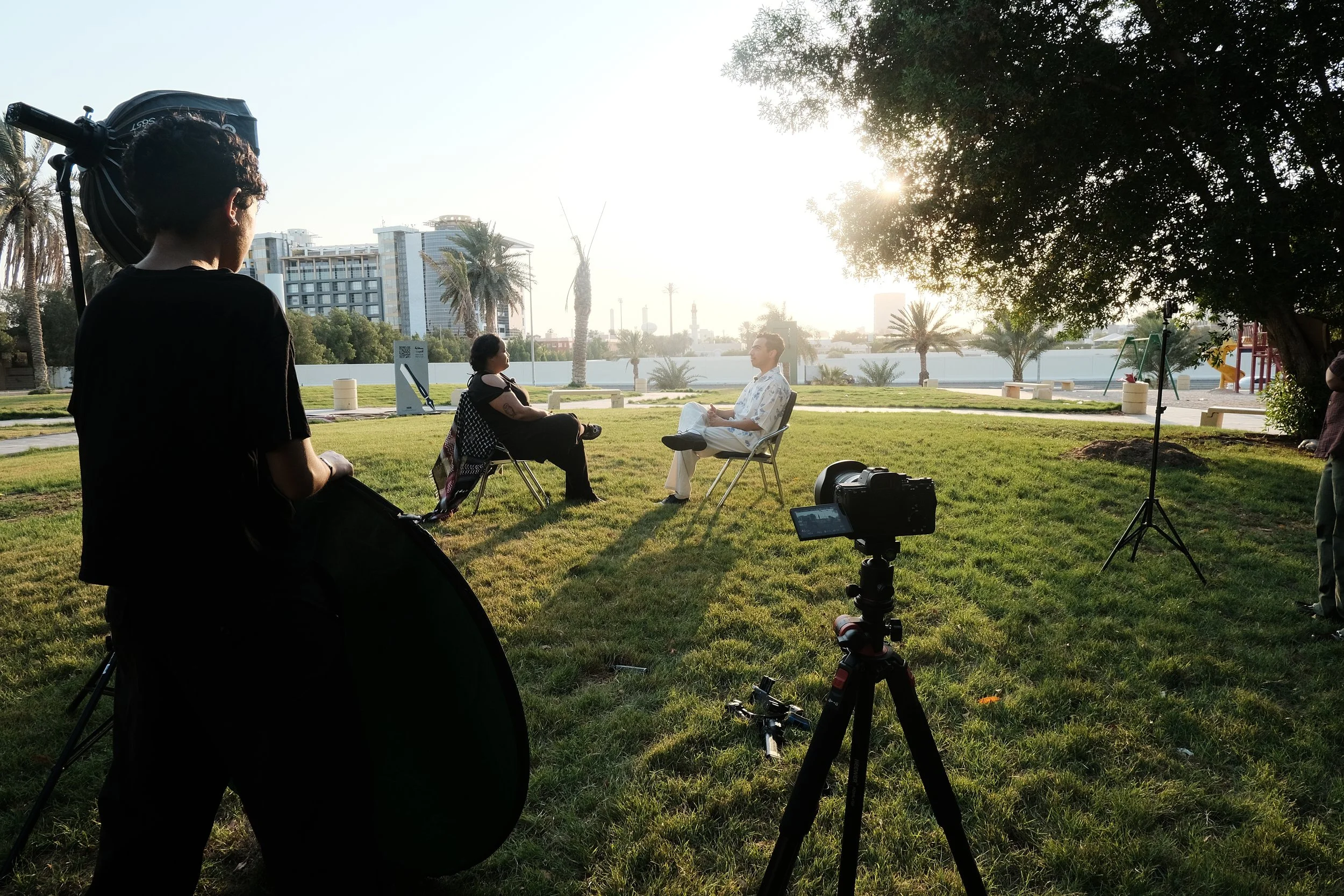
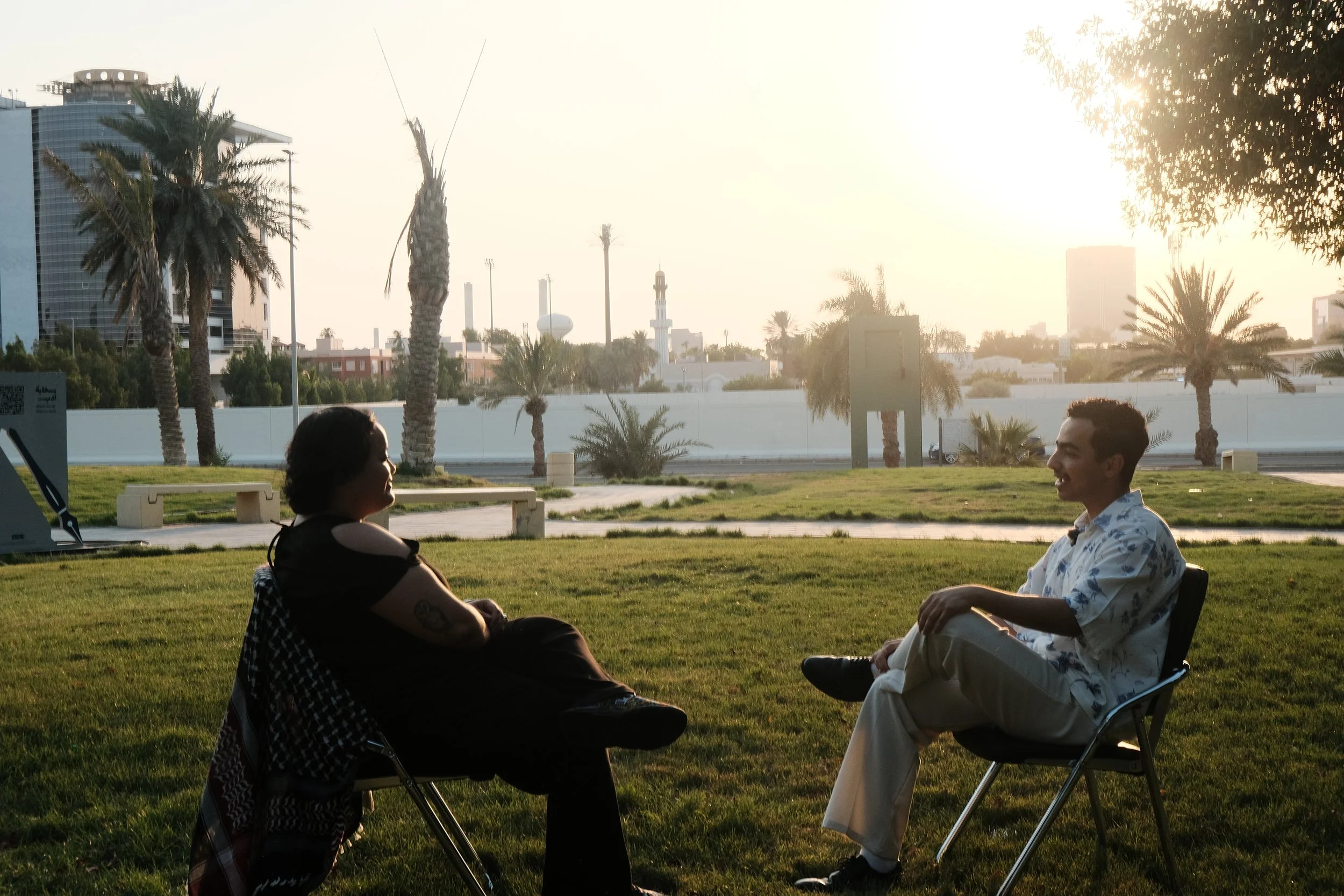
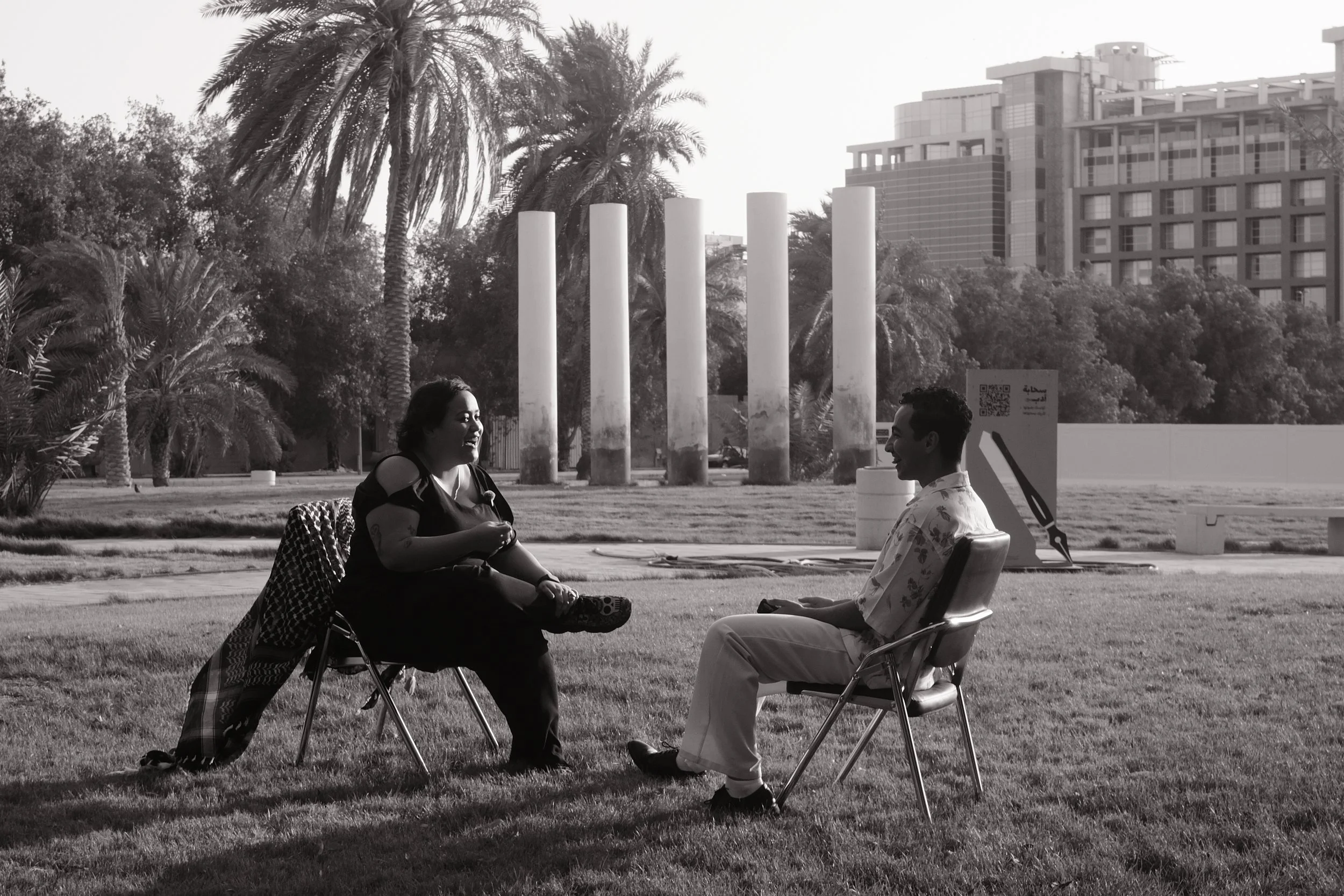
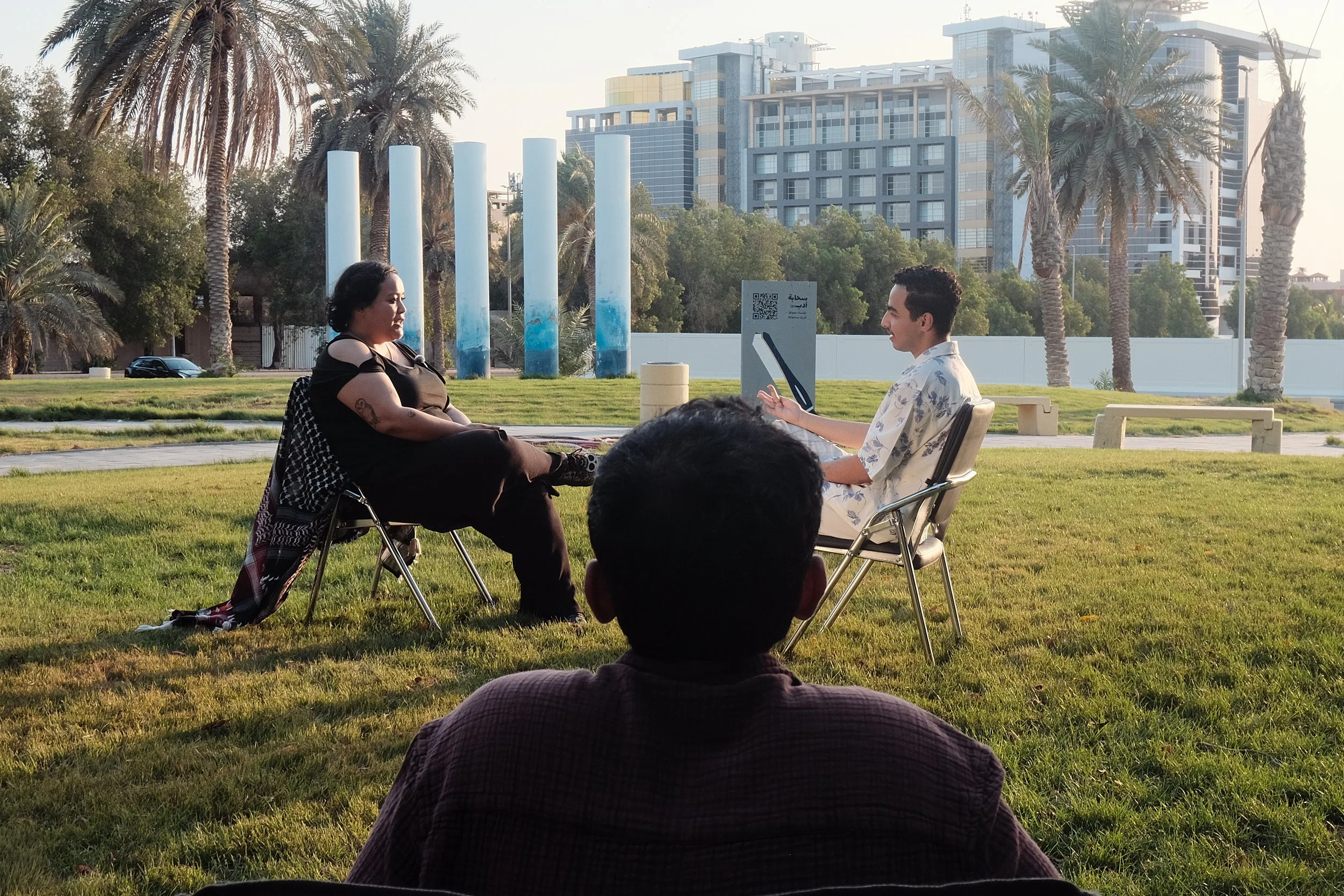
Snippets of the conversation and behind the scenes